Fishing kayaks
Sit on Top Fishing Kayak or Sit-Inside: Which Fits You
By the editorial team · Updated 2026-11-25 · Specs from the makers, checked Nov 2026
Quick answer. A sit on top fishing kayak is the default for most anglers: it is wide, easy to climb back onto after a fall and simple to rig. A sit-inside is narrower, usually lighter and keeps you drier, which helps in cool water and on long paddles.
Compare two kayaks
Use the compare tool to put a sit-on-top and a sit-inside next to each other and see width, weight and capacity line by line.
Specs and list prices from each manufacturer's product page (checked Nov 2026); 53 kayaks. We compare published specs; we have not tested these kayaks on the water. Prices change — check the maker's site.
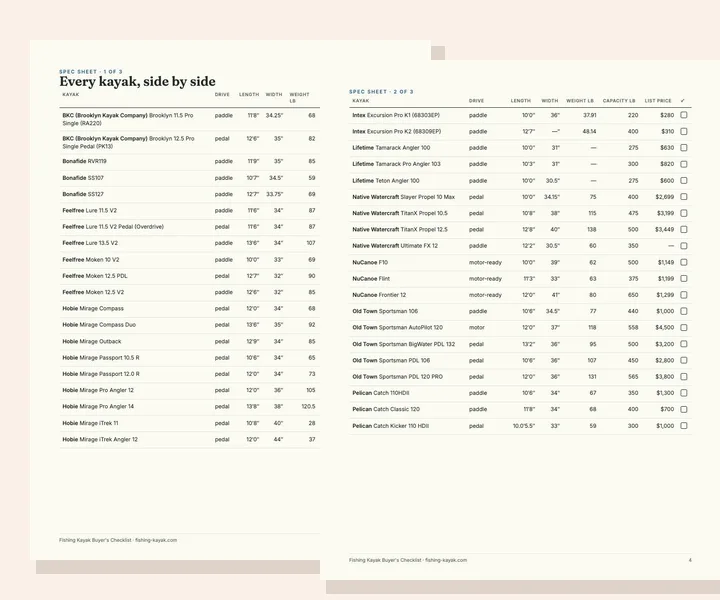
Shopping in person? The free buyer's checklist has a printable spec sheet of every kayak here.
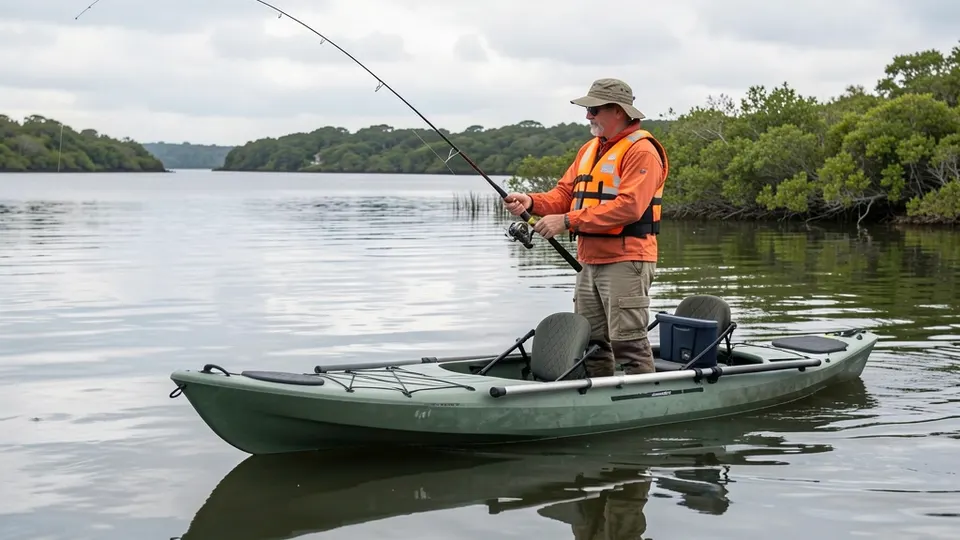
Almost every sit on top fishing kayak in our table, 48 of 53 models, uses an open deck. That is not an accident: an open deck is easy to rig with tracks and rod holders, you can stand on it, and if you fall off you can climb back on. The sit-inside design still has a place, though, and the choice matters more than most buyers expect.
This page compares the two designs using a paddle maker's guidance and manufacturer specs, not our own water testing.
How the two designs stay upright
Sit-on-tops get their stability mainly from width, while sit-ins rely more on edge, or secondary, stability as you lean 1. In practice a wide sit-on-top feels planted when you sit still or stand to cast, and a narrower sit-in feels livelier but more predictable when it is tipped on edge.
Our data shows the width gap. Fishing sit-on-tops in the table run from 30.5 in to 41 in wide for hardshells. The only sit-inside design we track, the Native Watercraft Ultimate FX 12, is 30.5 in wide, a hybrid with an open canoe-style cockpit and what Native calls sturdy standing ability.
Why most anglers choose a sit on top fishing kayak
Re-entry. A sit-on-top can be flipped back and re-boarded from the water, and it cannot swamp; a sit-in usually needs a roll or an assisted rescue 1. For anglers who fish alone, that difference is the main safety argument.
Deck space. Aqua-Bound calls sit-on-tops the best choice for fishing because the deck is open and customizable 1. Rod holders, accessory tracks, a fish finder and a crate all fit without cutting into a cockpit.
Standing. Most models in our table that makers describe as stand-up platforms are sit-on-tops. Examples include the Old Town Sportsman 106, a Double-U hull 34.5 in wide, and the Bonafide SS127, 33.75 in wide with PerchPads, a raised standing spot on each side.
Scupper holes and self-bailing
Sit-on-tops drain through scupper holes, tubes that run from the deck through the hull. Water that splashes in runs out on its own, which is what self-bailing means. The trade-off is that you sit lower relative to the waterline with some water around you.
One maker shows how much scuppers affect the numbers. NuCanoe rates the F10, a 39 in wide 10-footer, at 500 lb with the scuppers plugged and 350 lb self-bailing, a 30% drop for the open-scupper setting. If you plan to fish with plugs in, read which figure the maker means. Our weight capacity guide covers how to use these ratings.
Free printable · US Letter and A4
Get the Fishing Kayak Buyer's Checklist
Still deciding? The free Fishing Kayak Buyer's Checklist compares every model's width, weight and capacity on one printable sheet.
- Spec sheet of every kayak we track, to take to the store
- Capacity worksheet: you + gear → the kayak size you need
- Gear and safety checklist with the federal PFD rules
- Test-paddle questions and a pre-launch checklist
When a sit-inside makes more sense
Sit-ins are narrower and more efficient to paddle, are typically lighter, and often have covered hatches and bulkheads for storing gear on longer trips 1. If you paddle several miles to reach a spot, or fish in spring and fall, those points add up.
Compare two 12-footers in our data. The Native Ultimate FX 12 lists a 60 lb fitted hull and 350 lb capacity. The Perception Pescador Pro 12.0, a sit-on-top, lists 64 lb and 375 lb at 32.5 in wide. The weights are close here, so the bigger differences are the cockpit and how dry you stay. The sit-inside also gives up some deck space: rod holders and a crate have to fit around the cockpit rim instead of on an open, flat deck, and getting in and out at a muddy bank takes a little more care.
Cold water changes the answer
On a sit-on-top your legs and seat take spray and drips all day, and if you go in, you are fully immersed. The National Weather Service advises dressing for the water temperature, not the air, and always wearing a life jacket 2. The National Center for Cold Water Safety recommends thermal protection, a wetsuit or drysuit, when water is below 70°F 3.
A sit-inside keeps you drier in normal conditions, but it does not protect you after a capsize and is harder to re-enter. Either way, cold water calls for the right clothing first, and a sit-inside without bulkheads can fill with water after a capsize, which makes it heavy and hard to empty in deep water. Our kayak fishing safety page explains cold shock and what to wear.
Standing and carrying: what the specs show
Of the sit-on-tops in our table, 28 are described by their makers as suitable for standing, using phrases such as standing platform, stand-up stability or stand and cast. Makers that publish deck height give you one more clue: Bonafide lists 15.5 in for the SS107, whose PerchPads sit along the sides.
Weight is where sit-on-tops pay for their deck. Among 10- to 11-foot hardshells, published weights run from 51 lb for the Vibe Yellowfin 100 to 115 lb for the pedal Native TitanX Propel 10.5. If you load alone onto a roof rack, check the weight method each maker uses before you compare: some publish a bare hull, others the assembled boat with seat and drive. A cart that straps under the hull, or a keel wheel like the one Feelfree builds into the Moken 10 V2, often helps more than shaving a few pounds off the spec.
Whichever design you pick, the deck layout decides how you rig it. Our accessories guide covers rod holders, crates and anchor systems.
A quick way to decide
| If you... | Lean toward |
|---|---|
| Fish alone, stand to cast or carry lots of gear | Sit-on-top |
| Fish warm water or in summer | Sit-on-top |
| Paddle long distances to your spot | Sit-inside |
| Fish cool water often and dress for it | Either, with a drysuit or wetsuit |
| Want a pedal drive | Sit-on-top (all pedal models we track are sit-on-tops or inflatables) |
Once you have picked the design, the best fishing kayaks page shortlists models by category, and the buying guide goes through length, width and transport.
Frequently asked questions
Are sit-on-top kayaks safer for fishing?
For most anglers they are easier to recover from. Aqua-Bound notes that a sit-on-top can be flipped and re-boarded from the water and cannot swamp, while a sit-in usually needs a roll or assisted rescue. That matters most if you fish alone. Safety still depends on wearing a life jacket, dressing for the water temperature and practicing re-entry near shore before you need it.
Will I get wet in a sit-on-top kayak?
Usually yes, at least a little. Scupper holes let water that comes over the side drain out, but they also let some water up around the seat and your feet. Paddle drips and spray add more. Many anglers wear quick-dry pants in summer and a drysuit or wetsuit in cool water. A raised seat, which most fishing models have, keeps you somewhat drier.
Can you stand in a sit-inside kayak?
Most traditional sit-ins are too narrow and their cockpits too enclosed to stand comfortably. Hybrid designs are the exception: Native Watercraft describes its Ultimate FX 12, an open-cockpit sit-inside, as having sturdy standing ability. If standing to cast or sight-fish matters to you, a wide sit-on-top built as a standing platform is the more common choice.
Should I plug the scupper holes?
Plugging scuppers keeps water from rising onto the deck and can raise the rated capacity, but the boat then no longer drains itself. That is why some makers print two capacity figures for the same hull. Plugs make sense on calm water with a heavy load; in waves, open scuppers let splash drain away. Follow your maker's guidance for your model.
Sources
- Aqua-Bound (paddle manufacturer), 2021: How to Choose: Sit-on-Top vs. Sit-In Kayaks
- NOAA National Weather Service, 2026: Cold Water Hazards and Safety
- National Center for Cold Water Safety, 2026: Dress for the Water Temperature