Fishing kayaks
Pedal vs Paddle Kayak for Fishing
By the editorial team · Updated 2026-11-25 · Specs from the makers, checked Nov 2026
Quick answer. In the pedal vs paddle kayak choice, a pedal drive buys hands-free boat control and easier coverage of big water; a paddle kayak is lighter, cheaper and reaches the shallowest spots. In our dataset the median hard-shell pedal model costs about three times as much as the median paddle model and weighs roughly 20 lb more.
Compare two kayaks
Pick one pedal and one paddle model in the compare tool to see length, width, weight, capacity and list price side by side. It uses the same manufacturer specs as the table on this site.
Specs and list prices from each manufacturer's product page (checked Nov 2026); 53 kayaks. We compare published specs; we have not tested these kayaks on the water. Prices change — check the maker's site.
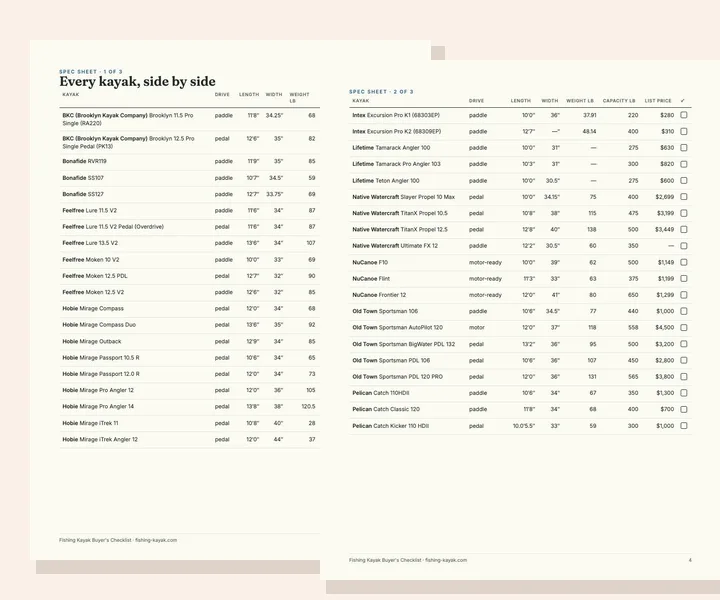
Shopping in person? The free buyer's checklist has a printable spec sheet of every kayak here.
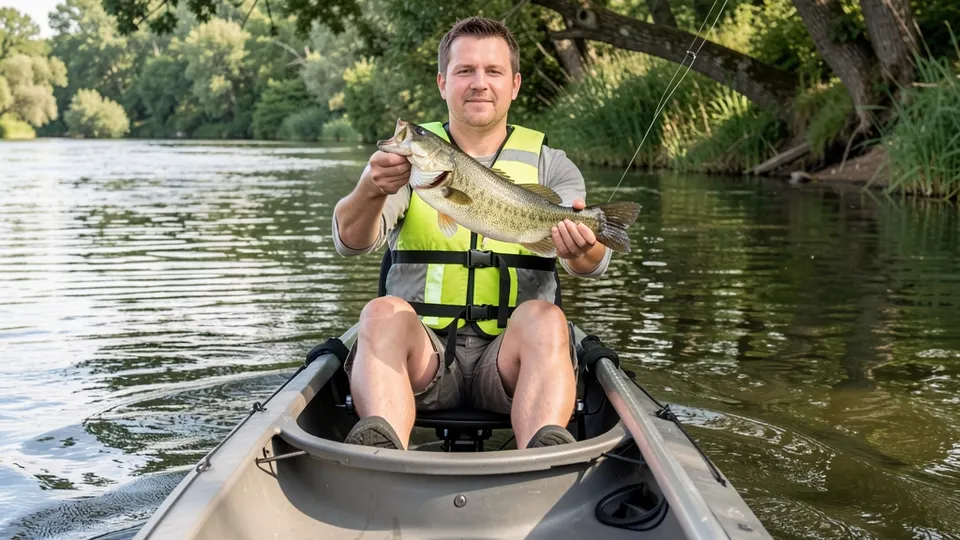
The pedal vs paddle kayak question usually comes down to one thing: how much you are willing to pay, in dollars and in pounds, to keep your hands on the rod. Both work for fishing. What changes is how you hold position in wind, how far you travel in a morning, how heavy the boat is on the roof rack and how shallow you can go.
This page lays out the trade-offs that kayak makers themselves describe, then puts numbers on weight and price from the manufacturer specs we collected. Everything here comes from spec sheets and maker guidance; nobody on our side paddled or pedaled these boats for this comparison.
What a pedal drive changes on the water
A pedal drive moves the kayak with your legs and steers it with a rudder, so both hands stay free for casting, working a lure or landing a fish. That is the headline benefit in Vibe Kayaks' own comparison, which also credits pedals with covering open lakes and bays more quickly 1.
The practical effect shows up in wind and current. With a paddle, every pause to cast lets the boat drift or spin, and correcting means putting the rod down. With pedals you can hold a line along a weed edge or keep the bow into a breeze while you fish.
The same source lists the costs: a higher price, the need for enough depth so the drive does not ground out, and propeller drives that weigh more and can foul in weeds. Its comparison also gives fin-style drives the edge over most props once the water gets shallow or weedy 1.
Pedal vs paddle kayak by the numbers
We split the hard-shell models in our dataset by propulsion and took the median of each manufacturer spec. These are our own calculations from published specs, not a market survey, and inflatables are left out because they skew weight downward.
| Spec (hard-shell only) | Pedal models | Paddle models |
|---|---|---|
| Models in dataset | 19 | 24 |
| Median hull weight | 90 lb | 68 lb |
| Median max capacity | about 450 lb | about 400 lb |
| Median list price | about $2,980 | about $1,000 |
| Lowest list price | $999.99 | $599.99 |
Prices in the table use each maker's regular (not sale) figure as shown in Nov 2026. Two models without a clear price are excluded from the price rows, and three paddle models without a stated weight are excluded from the weight row.
In 2020 Vibe described other top pedal brands at about $3,000 to $5,000 1. The current median in our data still sits inside that band, although a few entry pedal boats now start near $1,000 to $1,700.
Same hull, two prices
Some makers sell one hull with and without a drive, which isolates what the pedal system costs. Feelfree Lure 11.5 V2 lists at $999, while the Lure 11.5 V2 Pedal lists at $1,899 on the maker's site, checked Nov 2026. Both are listed at 87 lb and 425 lb capacity, so the difference is the drive, rudder and steering hardware.
Wilderness Systems Recon 120 is a paddle hull that accepts a pedal drive sold separately, at $1,699.99 list. The Recon 120 HD is the pedal version at $3,159 list and 122 lb manufacturer spec weight, against 101.4 lb for the paddle hull.
At the low end, Pelican Catch Kicker 110 HDII is a pedal kayak at $999.99 list, 59 lb and 300 lb capacity. Hobie Mirage Passport 10.5 R is $1,699 with a 325 lb rating. Entry pedal boats tend to carry less than larger pedal models, which matters once you add gear.
Free printable · US Letter and A4
Get the Fishing Kayak Buyer's Checklist
Get the Fishing Kayak Buyer's Checklist: a printable spec sheet with every pedal and paddle model side by side, so you can compare drive, weight and list price on one page.
- Spec sheet of every kayak we track, to take to the store
- Capacity worksheet: you + gear → the kayak size you need
- Gear and safety checklist with the federal PFD rules
- Test-paddle questions and a pre-launch checklist
Weight on land is part of the decision
A heavier boat is harder to car-top, drag to a ramp and store. The heaviest pedal models we list run past 120 lb before seat and drive: Old Town Sportsman PDL 120 PRO at 131 lb and Native TitanX Propel 12.5 at 138 lb manufacturer spec. Makers measure weight differently, some with the seat and drive and some as a bare hull, so compare the weight note for each model before deciding.
If you fish alone and load from a car roof, the gap of roughly 20 lb between median pedal and paddle hulls can decide the question on its own. A trailer or a cart changes that math. Inflatable pedal kayaks are another route; see inflatable fishing kayaks.
Steering, shallows and maintenance
Pedal kayaks steer with a rudder, usually from a hand lever beside the seat, so turning is a hand-and-leg job rather than a paddle stroke. Most pedal boats still carry a paddle for launching, shallow flats and backing off snags.
In skinny water, a paddle kayak wins outright: Vibe lists reaching the shallowest water as a paddle advantage, alongside lower cost and simpler gear 1. A drive also adds moving parts to rinse, inspect and occasionally repair. On the other side, the same source names holding position in wind and current, and lower speed, as the main paddle drawbacks.
If your water is a mix, a paddle hull that accepts an optional drive or motor mount keeps the upgrade open. Our sit-on-top fishing kayak page covers deck layouts that suit both.
Which one fits how you fish
A pedal kayak is easier to justify if you fish open lakes, bays or tidal water, troll for distance, or fish wind-exposed points where boat control matters more than shallow access. Budget around the median price above, plan for the extra weight, and compare drive types if you fish weedy water.
A paddle kayak makes more sense for creeks, small rivers, shallow ponds and marsh edges, for anglers who carry the boat alone, and for a first kayak at a lower cost. The money saved can go to a good PFD, an anchor trolley and a crate; see fishing kayak accessories.
For shortlists, see best pedal fishing kayaks and best budget fishing kayaks, or start from the step-by-step buying guide.
Frequently asked questions
Are pedal drive kayaks worth it?
For anglers who spend most days on open, wind-exposed water, usually yes, because boat control while casting is the hardest part of paddle fishing there. The cost is real: in our dataset the median hard-shell pedal model lists near $2,980 against about $1,000 for paddle models, and weighs about 20 lb more. For creeks, shallow ponds and car-topping alone, a paddle kayak often serves better.
How fast is a pedal drive kayak?
No reliable cross-brand speed figure exists in the specs we collected, so we leave the number out. Vibe Kayaks describes pedal drives as covering big lakes and bays faster than paddling, and lists slower travel as a paddle drawback. Real speed depends on hull length, load, wind and the paddler's fitness, so treat any single figure with caution.
How do you steer a pedal drive kayak?
Most pedal kayaks steer with a rudder controlled by a hand lever or handle next to the seat, while your legs drive the boat forward or, on some models, in reverse. You still carry a paddle for launching, very shallow water and pushing off snags. Check whether the rudder comes included, since some packages sell it separately.
What is a divorce kayak?
Paddlers use the phrase for two-seat kayaks, because steering one well takes two people stroking in rhythm and agreeing where to go. With fishing added, you also share casting room and argue over who handles the anchor. That is why many fishing couples end up in two solo boats, or one tandem with a pedal drive.
What are the best fishing kayaks?
That depends on what you fish from it. Our best fishing kayaks page sorts the models into use cases such as budget, pedal, big anglers and standing, all from manufacturer specs, and the comparison table filters by weight, capacity and price. The picks are spec comparisons, not on-water test results.
Sources
- Vibe Kayaks (manufacturer), 2020: Choosing a Pedal vs Paddle Kayak