Fishing kayaks
How to Choose a Fishing Kayak
By the editorial team · Updated 2026-11-25 · Specs from the makers, checked Nov 2026
Quick answer. To choose a fishing kayak, start with where you fish, then pick hull style and propulsion, size the capacity for you plus your gear, and only then compare length, width, weight and price. Transport is the step most buyers skip, and it rules out more boats than budget does.
Find a fishing kayak
The kayak finder narrows our 53 models by water type, propulsion, budget and the most weight you can lift. Answer four questions and it returns the models whose manufacturer specs fit.
Our filter on manufacturer specs. Length thresholds for water type and the 70% capacity guideline are rules of thumb.
Specs and list prices from each manufacturer's product page (checked Nov 2026); 53 kayaks. We compare published specs; we have not tested these kayaks on the water. Prices change — check the maker's site.
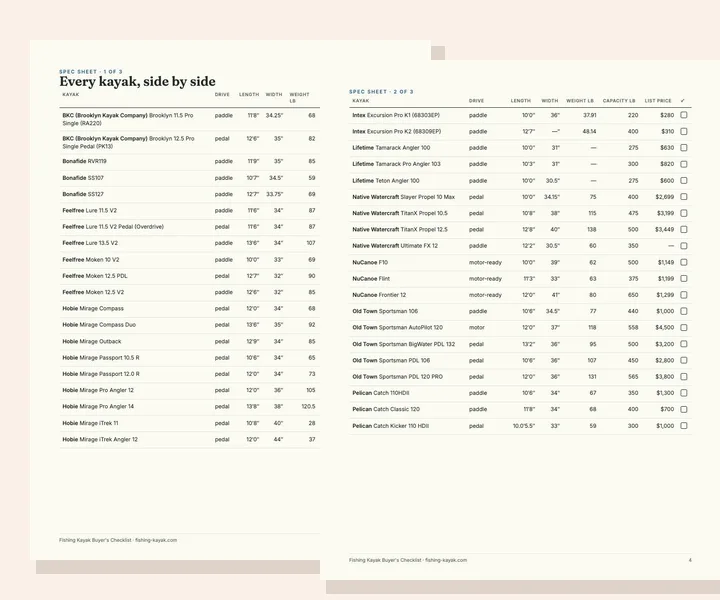
Shopping in person? The free buyer's checklist has a printable spec sheet of every kayak here.
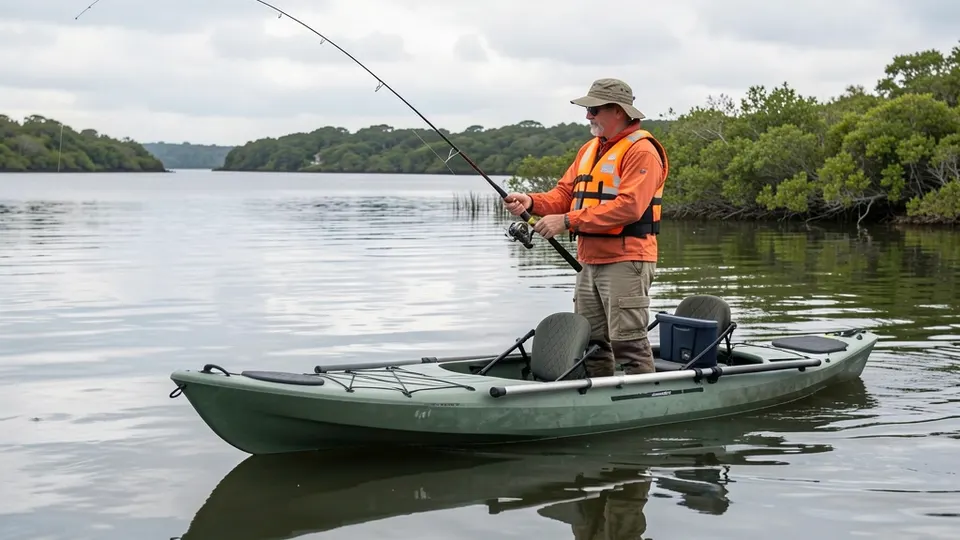
Learning how to choose a fishing kayak is mostly about deciding in the right order. Price and looks come last; water, propulsion and the load you carry come first, because they rule out whole categories of boats before you compare a single model.
The steps below follow that order. Where we quote specs or prices they come from manufacturer pages, with list prices checked in Nov 2026. Our comparisons rest on what makers publish; we have not run on-water tests of these boats.
How to choose a fishing kayak, step 1: your water
Write down the two or three places you will fish most. Small ponds, creeks and slow rivers favor shorter, lighter boats you can turn quickly and carry to the bank. Big lakes, bays and tidal water favor longer hulls that track straight and cover distance, and that is where pedal drives earn their cost.
Shallow, weedy or rocky water matters too. It is hard on propeller drives and easy on paddle kayaks and fin drives. Moving water with obstacles calls for a boat that turns easily and that you can drag over a gravel bar without worry.
Step 2: Pick a hull style
For most anglers this step is quick, because the fishing market is built around sit-on-tops. The open deck takes rod holders, tracks and a crate without fuss, and Aqua-Bound points out that a sit-on-top can be flipped back over and climbed onto from the water 1.
Sit-inside kayaks are typically narrower, more efficient and lighter, with covered storage, but need a roll or an assisted rescue after a capsize 1. Inflatables trade some rigidity for easy storage and transport. Our pages on sit-on-top fishing kayaks and inflatable fishing kayaks go deeper on each.
Step 3: Pedal, paddle or motor
Decide this before you shortlist hulls, because it moves the price band more than any other choice. A pedal drive frees your hands for fishing but raises price and weight; a paddle kayak is cheaper, lighter and better in very shallow water. The full trade-off is on the pedal vs paddle kayak page.
A motor-ready hull such as Pelican Catch Mode 110 or NuCanoe F10 lets you start with a paddle and add a trolling motor later. Adding a motor usually changes how your state treats the boat; see kayak registration.
Free printable · US Letter and A4
Get the Fishing Kayak Buyer's Checklist
Take the Fishing Kayak Buyer's Checklist with you to the shop: the seven decisions on one page, plus a spec sheet of every model to tick off as you narrow it down.
- Spec sheet of every kayak we track, to take to the store
- Capacity worksheet: you + gear → the kayak size you need
- Gear and safety checklist with the federal PFD rules
- Test-paddle questions and a pre-launch checklist
Step 4: Size the capacity for your real load
Treat the printed maximum as a ceiling. Brooklyn Kayak Company's rule of thumb is to load a kayak to no more than about 70% of it 2, which means dividing your own total of body weight plus gear by 0.7 to get the rating to look for. Other rules give different answers, and a few makers also print a lower usable or seat limit.
The fishing kayak weight capacity page explains the formulas and where they conflict, and has a calculator for your own numbers.
Step 5: Fishing kayak size, 10 ft vs 12 ft
Length and width set how a kayak tracks, how much it carries and how much it weighs. Shorter boats turn faster and fit small cars and garages; longer boats glide further per stroke and carry more.
One maker's pair shows the typical gap. Vibe Yellowfin 100 is 120 in long, 51 lb and rated at 375 lb, at $849.99 list. The Yellowfin 120 is 144 in, 66 lb and 400 lb, at $949.99 list, both manufacturer specs with prices from the maker's site, checked Nov 2026.
Across all hard-shell models we list, the median list price rises from about $1,000 for boats up to 10 ft 8 in to about $1,500 for 11 ft 6 in to 12 ft 3 in, and about $1,730 for 12 ft 6 in and longer. That is our calculation from published prices, and it mixes pedal and paddle boats.
Step 6: The most stable fishing kayak is usually the widest
On a sit-on-top, beam does most of the work of keeping you upright 1, so fishing hulls run wide compared with touring kayaks. Most of our models fall between 33 and 35 in. The widest hard-shells we list are NuCanoe Frontier 12 at 41 in and Native TitanX Propel 12.5 at 40 in; the inflatable Hobie Mirage iTrek Angler 12 is 44 in.
Width costs speed and weight, and hull shape matters as much as the number. If you want to stand and cast, check whether the maker describes the deck as built for standing; 31 of our 53 models do. That is a maker claim, not a test result, so try standing in calm, shallow water first.
Step 7: Transport and budget
Ask how you will move the boat before you look at price. A kayak you cannot lift onto your vehicle alone stays in the garage. The lightest hard-shells we list are about 51 to 60 lb; several pedal models are over 120 lb before seat and drive. Makers measure weight differently, so read each model's weight note. Carts, trailers and inflatables change the picture.
On price, our data splits into 19 budget models under $1,000, 19 mid-range at $1,000 to $2,499 and 14 premium at $2,500 or more, with 2 lacking a clear list price. Leave room in the budget for a PFD, paddle, anchor system and storage; see fishing kayak accessories. Shortlists by budget are on best budget fishing kayaks and best fishing kayaks.
Frequently asked questions
What size fishing kayak do I need?
Start from your total load, not your height. Add body weight and gear, divide by 0.7, and look for at least that maximum capacity. Then match length to your water: around 10 ft for small water and tight transport, around 12 ft or longer for big lakes and distance. Taller or heavier anglers usually do better in wider, longer hulls.
Is a 10 ft or 12 ft kayak better for fishing?
Neither wins everywhere. Around 10 ft you get a lighter, cheaper boat that spins quickly in creeks and slides into a small car or garage. Around 12 ft you get straighter tracking and more carrying room for long days on open water, at the cost of weight. If your fishing is split between both, a hull between 11 and 12 ft is a common middle ground.
What is the most stable type of fishing kayak?
Wide sit-on-tops and wide inflatables give the most initial stability, because sit-on-tops get stability from width. Hulls built for standing usually combine width with a flat or tunnel-shaped bottom. Stability claims come from makers, not independent tests, so if standing matters, try it in calm, shallow water before relying on it.
Should a beginner buy a sit-on-top or sit-in kayak for fishing?
A sit-on-top is the easier start for most new anglers. Rigging is simpler on an open deck, and recovering from a spill means flipping the boat and scrambling back aboard. A sit-inside is lighter and more efficient for touring but needs a roll or assisted rescue, which takes practice to learn.
Sources
- Aqua-Bound (paddle manufacturer), 2021: How to Choose: Sit-on-Top vs. Sit-In Kayaks
- Brooklyn Kayak Company (manufacturer), 2023: Clarifying Kayak Weight Capacity