Fishing kayaks
Do You Need to Register a Kayak?
By the editorial team · Updated 2026-11-25 · Specs from the makers, checked Nov 2026
Quick answer. Do you need to register a kayak? It depends on your state. Many states register only motorized boats, some also register kayaks, and some require a separate permit instead. Adding a trolling motor usually turns a kayak into a motorboat for registration, so check your state's rules before you launch.
Do you need to register a kayak is one of the most searched questions from new kayak anglers, and the honest answer is that it depends on where you paddle. Registration is set by each state, and the rules range from no registration at all for paddle kayaks to registration of every watercraft.
This page summarizes the Coast Guard's state-by-state overview with examples, explains why a motor changes things, and shows how to check your own state. It is a summary, not legal advice; state rules change, so confirm with your state agency.
Do you need to register a kayak? It varies by state
There is no single national kayak registration rule. Each state decides which vessels it registers; some register only motorized boats, others include canoes and kayaks 1.
The Coast Guard's 2024 statistics put the total at 11,674,073 registered recreational vessels, of which 628,507 were paddlecraft, counted only where states require it 1. That small paddlecraft share reflects how many states leave paddle kayaks out.
State examples
The Coast Guard's 2024 table of state registration scope gives a sense of the range 1:
| State | What is registered (2024 scope) |
|---|---|
| CA, NY, AZ, MA, VA | All motorized vessels |
| FL | All motorboats, plus non-motorized vessels over 16 ft |
| OH, SC | All watercraft |
| MI | All watercraft except manually propelled boats 16 ft or less |
| MN | All watercraft except non-motorized 10 ft or less |
| IA | Excludes canoes, kayaks and SUPs under 13 ft |
| NJ | Excludes canoes and kayaks |
| AK, IL, WY | Non-motorized voluntary; OK optional |
Length thresholds matter. In Minnesota a 10 ft paddle kayak falls outside registration and an 11 ft one does not; in Iowa the line is 13 ft. Check the exact rule for your boat's length, and remember the table describes 2024.
Motorized kayak registration
Adding a motor changes the category. For incident reporting and registration, the Coast Guard counts any canoe or kayak with a motor as an open motorboat; paddlecraft means non-motorized only 1. In most states that means a kayak with a trolling motor needs registration and numbers like any other motorboat, even where paddle kayaks are exempt.
This applies to motor-ready hulls once you mount a motor, such as Pelican Catch Mode 110, NuCanoe Frontier 12 or Wilderness Systems Recon 120. Old Town notes on its page for the Sportsman AutoPilot 120, which has an integrated motor, that registration as a motorized vessel is required in most states. Pedal kayaks without a motor are generally treated as paddlecraft, but confirm how your state classifies them.
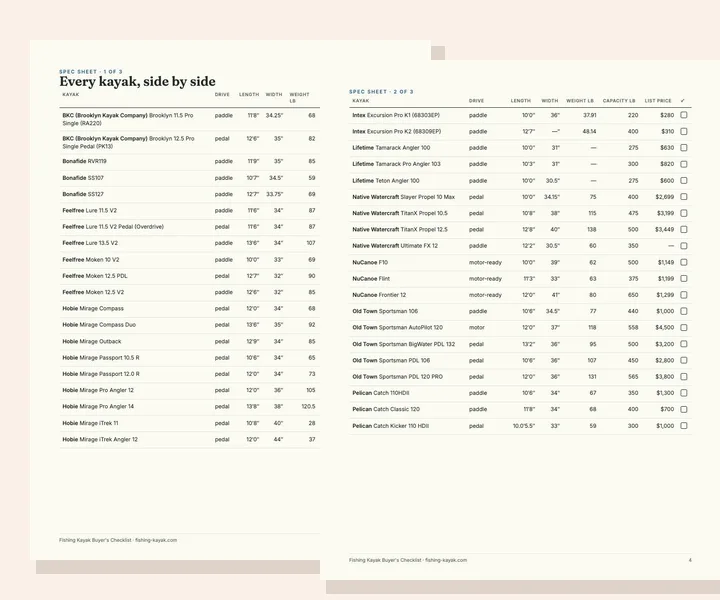
Free printable · US Letter and A4
Get the Fishing Kayak Buyer's Checklist
The Buyer's Checklist includes state registration notes for paddle, pedal and motor kayaks, so you can see what applies to the boat you are considering before you buy.
- Spec sheet of every kayak we track, to take to the store
- Capacity worksheet: you + gear → the kayak size you need
- Gear and safety checklist with the federal PFD rules
- Test-paddle questions and a pre-launch checklist
Length thresholds and the kayaks in our data
Several states draw the line by length, so the length on the manufacturer spec sheet can decide whether you register. Using the 2024 scopes above 1 and the lengths in our dataset:
In Iowa, where canoes and kayaks under 13 ft are excluded, most fishing kayaks fall below the line. Five models in our data are 13 ft or longer: Vibe Sea Ghost 130 at 156 in, Feelfree Lure 13.5 V2 at 162 in, Hobie Mirage Compass Duo at 162 in, Old Town Sportsman BigWater PDL 132 at 158 in and Hobie Mirage Pro Angler 14 at 164 in.
In Minnesota, non-motorized boats 10 ft or less are excluded. Eight models in our data are listed at exactly 120 in, such as Vibe Yellowfin 100, so they sit right at that line, while anything longer is in scope. In Florida and Michigan, where the paddle threshold is 16 ft, none of the models we list is that long; the longest is 164 in.
These are our readings of the published scope and maker lengths, not a ruling. Measure your own boat and ask the state if it is close to a threshold.
Permits that are not registration
Some states that do not register paddle kayaks still require a permit. Pennsylvania requires unpowered boats such as kayaks to carry either a registration or a launch permit to use Fish and Boat Commission and State Park launch areas 2.
Oregon goes further. Since a 2025 law, every non-motorized boat operator needs a Waterway Access Permit regardless of boat length, with youth 13 and under exempt 3. The Oregon State Marine Board lists Boat Oregon Store prices of $6 for 7 days, $20 for 1 year and $35 for 2 years, plus a $1.50 portal fee. The same FAQ page also lists $8, $22 and $37 including a $2 fee through the state's fishing license system 3, so the price depends on where you buy it.
How to check your state
Search for your state's boating agency; it is often part of the fish and wildlife or natural resources department. Look for its registration page and answer three questions: does it register non-motorized boats, is there a length threshold, and is there a separate launch or access permit.
Then check the details that catch people out: whether rules differ on state-managed lakes or launch areas, whether out-of-state boats are covered by home-state registration and for how long, and what changes if you add a motor later. If you fish across a state line, check both states.
Registration is separate from fishing licenses and safety gear. You still need a fishing license where you fish, and life jacket rules apply whether or not the kayak is registered; see kayak fishing safety. If you are still deciding between a paddle, pedal or motor-ready boat, factor registration into the choice; see how to choose a fishing kayak.
Frequently asked questions
Do you need to register a kayak without a motor?
In many states, no. A number of states register only motorized vessels, while others register all watercraft or use length thresholds. Some, such as Pennsylvania and Oregon, require a launch or access permit instead of or alongside registration. Check your state boating agency, because the answer depends entirely on where you paddle.
Does a kayak with a trolling motor need to be registered?
Usually yes. The Coast Guard counts a kayak with a motor as an open motorboat for registration purposes, and most states register motorized vessels. That generally means registration numbers and any equipment rules for motorboats. Confirm with your state, since the exact rules and fees differ.
Do pedal kayaks need to be registered?
A pedal kayak without a motor is human-powered, so it is generally treated like a paddle kayak and follows the same state rule. Where paddle kayaks are exempt, pedal kayaks usually are too, and where all watercraft are registered, they are included. Because classification can vary, check how your state treats pedal drives.
How much does it cost to register a kayak?
It varies by state, and in many states a paddle kayak costs nothing because no registration is required. Where permits apply, prices are set by the state. Oregon's Waterway Access Permit, for example, is listed at $20 for one year through the Boat Oregon Store, plus a portal fee. Check your state agency for current fees.
Sources
- U.S. Coast Guard, Office of Auxiliary and Boating Safety, 2025: Recreational Boating Statistics 2024
- Pennsylvania Fish and Boat Commission, 2026: Kayak Fishing
- Oregon State Marine Board, 2026: AIS / Waterway Access Permit FAQs