Fishing kayaks
Pedal Fishing Kayak Comparison for 2026
By the editorial team · Updated 2026-11-25 · Specs from the makers, checked Nov 2026
Quick answer. A pedal fishing kayak lets you move and steer with your legs and a rudder, so both hands stay on the rod. In our data pedal models start at $999.99 and reach $4,999, and they weigh more than paddle boats of the same length. They pay off on big, open water, less so in skinny creeks.
Compare fishing kayaks
The table is pre-filtered to the 21 pedal models we track. Sort by list price, hull weight or capacity, or switch the filter to compare against paddle boats.
Specs and list prices from each manufacturer's product page (checked Nov 2026); 53 kayaks. We compare published specs; we have not tested these kayaks on the water. Prices change — check the maker's site.
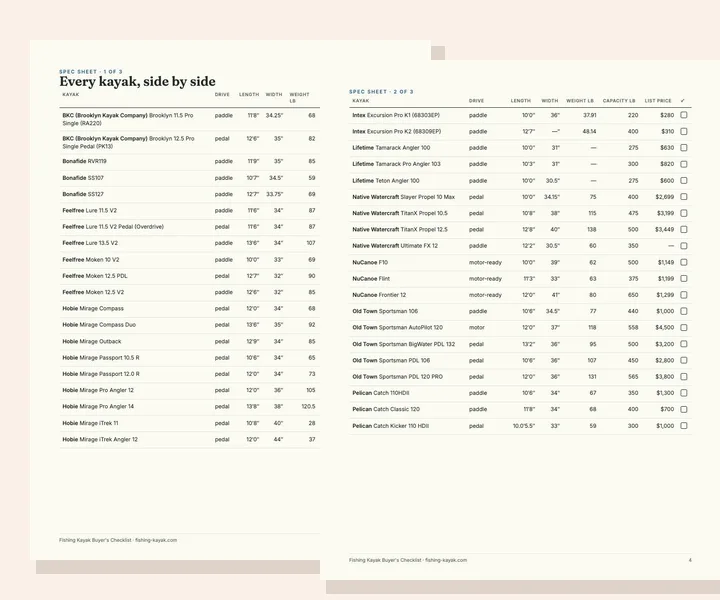
Shopping in person? The free buyer's checklist has a printable spec sheet of every kayak here.
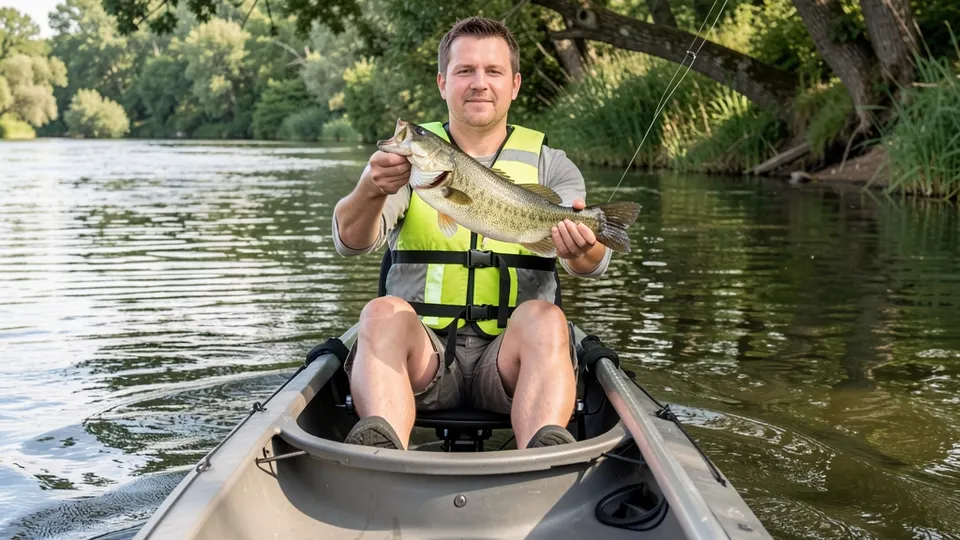
A pedal fishing kayak replaces the paddle stroke with a leg-driven propeller or fin drive under the hull, plus a rudder you steer with a hand lever. The appeal is simple: you can hold position, troll and fight a fish without putting the rod down.
We track 21 pedal models from Hobie, Old Town, Native Watercraft, Wilderness Systems, Pelican, Feelfree, BKC and Perception. Everything below is a manufacturer spec and a list price on the maker's site, checked Nov 2026. We compare published numbers; we did not pedal these boats on the water.
Pedal fishing kayak prices, from entry to flagship
Pedal drives cost money to build, and it shows. These are the list prices along the ladder:
| Model | Length | Hull weight (as published) | Capacity | List price |
|---|---|---|---|---|
| Pelican Catch Kicker 110 HDII | 125.5 in | 59 lb | 300 lb | $999.99 |
| Feelfree Moken 12.5 PDL | 151 in | 90 lb | 375 lb | $1,399 |
| Hobie Mirage Passport 10.5 R | 126 in | 65 lb | 325 lb | $1,699 |
| BKC Brooklyn 12.5 Pro Pedal | 150 in | 82 lb | 550 lb | $1,727 |
| Hobie Mirage Compass | 144 in | 68 lb | 400 lb | $2,599 |
| Native Slayer Propel 10 Max | 120 in | 75 lb | 400 lb | $2,699 |
| Old Town Sportsman BigWater PDL 132 | 158 in | 95 lb | 500 lb | $3,199.99 |
| Hobie Mirage Pro Angler 14 | 164 in | 120.5 lb | 600 lb | $4,999 |
Half of the pedal hardshells with a published price list at about $2,980 or more (our arithmetic); the pedal vs paddle page sets that against paddle boats. Vibe Kayaks made the same point about cost back in 2020, when it put competing top-brand pedal boats at roughly $3,000 to $5,000 1.
Why published weights are hard to compare
Pedal boats are heavy, and makers report that weight in different ways. Hobie gives a fitted hull weight and a separate rigged weight: the Mirage Compass is 68 lb fitted and 87 lb fully rigged. Old Town lists the assembled boat: the Sportsman PDL 106 is 107 lb with the seat (6 lb) and pedal console (18 lb) itemized separately. Feelfree lists the Moken 12.5 PDL at 90 lb without seat and drive and 111 lb with both.
So before comparing, ask what you will actually lift. Many pedal drives lift out of the hull, which lets you carry the boat and the drive separately. Part of the weight gap you see between brands is simply how each maker counts.
Props, fins and shallow water
Pedal drives come in two families. Propeller drives push like a small boat prop and usually give instant reverse; Wilderness Systems advertises instant forward and reverse on the Helix PD drive of the Recon 120 HD. Fin drives, like Hobie's MirageDrive, push with a pair of fins instead of a prop.
Both need some water under the hull. Vibe notes that pedal kayaks can ground out in the shallows, that prop drives are heavier and snag weeds, and that fin drives handle shallows and weeds better than most props 1. If you fish weedy flats or skinny rivers, check whether the drive kicks up on impact and how easily it lifts out while you are seated. A drive that you can pull up in seconds lets you pole or paddle across a shallow bar and drop it again on the other side.
Free printable · US Letter and A4
Get the Fishing Kayak Buyer's Checklist
Comparing pedal boats by weight and capacity? The free Fishing Kayak Buyer's Checklist lists all 21 side by side, with each maker's weight method marked.
- Spec sheet of every kayak we track, to take to the store
- Capacity worksheet: you + gear → the kayak size you need
- Gear and safety checklist with the federal PFD rules
- Test-paddle questions and a pre-launch checklist
Who should buy a pedal kayak
A pedal boat makes the most sense if you fish large lakes, bays or tidal water where wind and current push you off a spot, or if you troll. Vibe lists hands-free control and faster coverage of big water as the main gains 1.
A paddle boat is still the better call if you fish small ponds, creeks with riffles or very shallow flats, if you carry the kayak far from the car, or if your budget is under $1,500 including gear. For a head-to-head on these trade-offs, read pedal vs paddle kayak. A useful test before you spend the money: count how many of your last ten trips were on open water where wind pushed you off a spot. If it was most of them, pedals will change how you fish. Some paddle hulls, such as the Wilderness Systems Recon 120, accept a pedal drive later, which lets you split the cost.
A pedal shortlist by situation
You carry the boat alone. The Hobie Mirage Passport 10.5 R lists a 65 lb fitted hull (75 lb rigged) at $1,699. For far less weight, the inflatable Hobie Mirage iTrek 11 lists a 28 lb fitted hull.
You are a big angler on a mid budget. The BKC Brooklyn 12.5 Pro Pedal lists 550 lb capacity, 5 rod holders and a hand-controlled rudder for $1,727.
You want to stand and sight-fish. The Hobie Mirage Outback and Old Town Sportsman PDL 120 PRO are both described by their makers as standing platforms; the Old Town adds 150 in of accessory track and a bow-mount motor option.
You may add a motor later. The Native TitanX Propel 12.5 has bow motor mount inserts and battery storage built in. Its fitted hull is 138 lb, so plan on a trailer or a truck bed.
Owning a pedal drive
A pedal drive is a mechanical part that lives in sand, salt and weeds, so follow the maker's manual for rinsing, inspection and spare parts. Practically, that means rinsing the drive after every trip, checking the prop or fins for fishing line wrapped around the shaft, and keeping the rudder lines adjusted.
Moving between lakes adds a legal side. Iowa DNR asks paddlers to clean, drain and dry the kayak and all gear between waters, and to let it dry for 5 days or more where possible, to stop invasive species 2. A drive well collects weeds, so clean it out before you leave the ramp. Check your own state's rules on aquatic invasive species too.
Frequently asked questions
Can you add a pedal drive to a paddle kayak?
Only if the hull was designed for it. Wilderness Systems sells the Recon 120 as a paddle hull that accepts its Helix PD pedal drive, sold separately, and several makers sell the same hull in paddle and pedal versions. A kayak without a drive well cannot simply be converted. If you think you may want pedals later, look for a hull listed as pedal-drive ready.
Can you stand in a pedal fishing kayak?
Many are built for it. Hobie describes the Mirage Outback as having an extra-wide standing deck and calls the Pro Angler 12 a stand-and-cast boat, and Old Town describes its Sportsman PDL hulls in terms of stand-up stability. Not every pedal model mentions standing, so check the maker's page. Practice in calm, shallow water first, with the drive locked down and your life jacket on.
Can you use a pedal kayak in shallow water?
Only up to a point. The drive sits below the hull, so it can hit bottom in very shallow water. Vibe Kayaks notes that pedal boats can ground out and that fin drives handle shallows and weeds better than most propeller drives. Most drives can be pulled up or removed, so you can switch to a paddle for the last stretch to the bank.
Do pedal kayaks need to be registered?
A pedal kayak without a motor is treated as non-motorized paddlecraft by the US Coast Guard, so whether it needs registration depends on your state. Some states register only motorized boats; others also cover canoes and kayaks over a certain length. Adding a trolling motor changes that, because the USCG counts a kayak with a motor as an open motorboat. Check your state before you launch 3.
Sources
- Vibe Kayaks (manufacturer), 2020: Choosing a Pedal vs Paddle Kayak
- Iowa Department of Natural Resources, 2026: Ready to Kayak Fish
- U.S. Coast Guard, Office of Auxiliary and Boating Safety, 2025: Recreational Boating Statistics 2024