Fishing kayaks
Fishing Kayak Accessories: A Practical Setup Guide
By the editorial team · Updated 2026-11-25 · Specs from the makers, checked Nov 2026
Quick answer. Fishing kayak accessories fall into two groups: gear the rules or basic safety require, such as a life jacket, a light at night and in some states a sound device, and gear that makes fishing easier, such as rod holders, an anchor system, a crate and a fish finder. Buy the first group before the second.
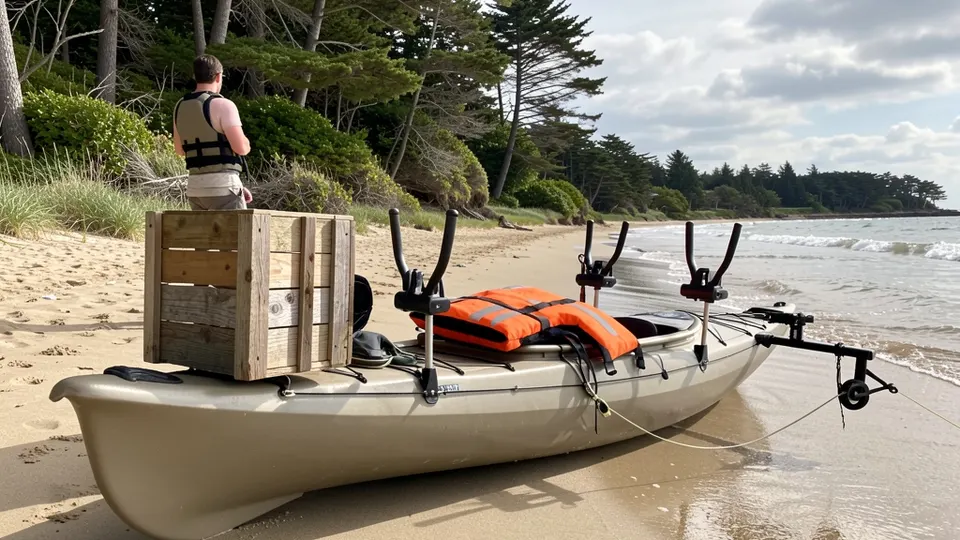
It is easy to spend as much on fishing kayak accessories as on the boat. The order matters: a few items are required or close to it, and the rest depend on how and where you fish. Every item also adds weight, which counts against the boat's capacity.
This page covers what each piece of kayak fishing gear does and when it is worth having. It does not recommend specific products. For the rules behind the safety items in more depth, see kayak fishing safety.
Required fishing kayak accessories: life jacket, light, sound
The life jacket comes first on any gear list, since every person aboard needs a wearable USCG-approved one 1. Buy one you will keep on all day: a paddling or fishing cut with high back flotation clears the seat back, and front pockets hold pliers and leader. Some states require wearing it in certain seasons; the safety page has examples.
Dawn and dusk sessions need a white light you can show quickly; the navigation rule for paddle craft is explained on the safety page 2. Anglers usually carry a waterproof headlamp, a flashlight on a lanyard or a pole light mounted at the stern, which also helps powerboats see you.
Some states require a sound device. Pennsylvania, for example, requires a device able to make a prolonged blast of 4 to 6 seconds on unpowered boats 3. A plastic whistle tied to the PFD is the usual answer.
Basic safety kit
Salt water and the Great Lakes bring extra signal rules after dark, which the safety page covers. For everyday kit, Iowa DNR's kayak fishing checklist adds a first-aid kit and a phone in a dry bag 4. Neither is legally required in most places, but both are cheap and small. A paddle leash belongs here too: the same source advises securing your paddle and tackle.
Kayak rod holders
Rod holders keep rods out of the water while you paddle, land a fish or retie. Most fishing kayaks come with some. In our data, makers list from 2 holders on many entry models up to 7 on the Hobie Mirage Pro Angler 14, and several makers do not state a count at all.
Flush-mount holders behind the seat are good for carrying and trolling. Adjustable holders in front of you suit trolling and bait rigs where you watch the tip. Vertical holders in a crate keep rods upright and out of the way of casts. If you need more, rail or track systems let you add holders without drilling.
Anchor system and anchor trolley
Holding a spot in wind or current is the main problem kayak anglers face without a pedal drive. For a kayak, the anchor itself stays small; the Iowa DNR guideline is to keep it to roughly 10 lb or under 4. In shallow water, a stake-out pole pushed into the bottom does the same job with less line to manage.
An anchor trolley is a loop of line along the side of the hull with a pulley at each end. It lets you move the anchor point from bow to stern so the kayak sits in the angle you want against wind or current. Anchoring from the side is a capsize risk, which is the point of the trolley. Some boats come with one; Native lists an anchor trolley on the Ultimate FX 12. In strong current, anchoring a kayak is a hazard in itself; many anglers drift instead.
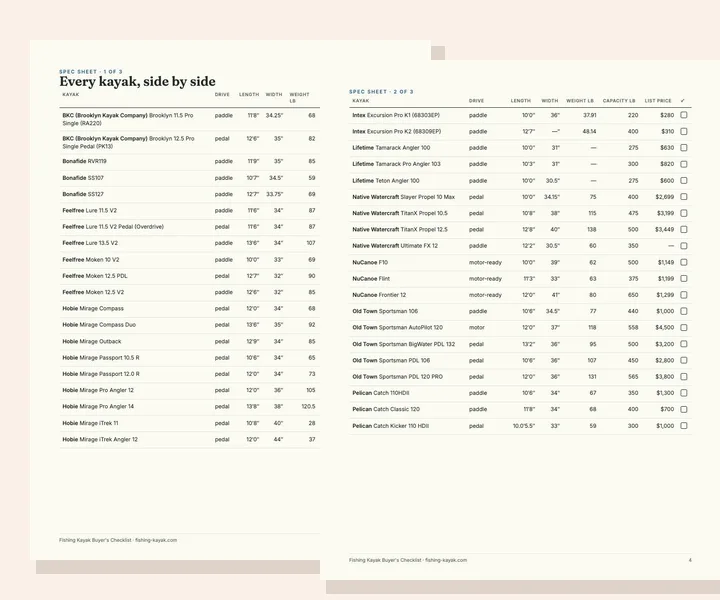
Free printable · US Letter and A4
Get the Fishing Kayak Buyer's Checklist
Print the gear and safety checklist from the Buyer's Checklist and tick it off before every launch, from PFD and light to anchor, crate and dry bag.
- Spec sheet of every kayak we track, to take to the store
- Capacity worksheet: you + gear → the kayak size you need
- Gear and safety checklist with the federal PFD rules
- Test-paddle questions and a pre-launch checklist
Crate, storage and dry bags
A milk-crate-style box in the rear tank well is the standard way to organize tackle trays, tools and extra rods. Add a bungee or strap so it stays put when you shift weight. A soft cooler fits in the same well or behind the seat.
Keep anything that cannot get wet, such as keys, wallet and spare clothes, in a dry bag tethered to the boat. Sit-on-tops are self-bailing, so the deck and tank well will be wet; plan for it rather than hoping.
Fish finder and electronics
A fish finder shows depth, bottom structure and fish, which matters most on lakes and reservoirs where structure is not visible. On a kayak it needs a transducer mount, a battery and somewhere to place the screen. Several hulls are designed for this: Feelfree lists a removable sonar pod on the Lure 11.5 V2, for example.
A battery adds weight to your load, so count it in your capacity estimate. On motorized setups, plan electronics and motor power together.
Fishing kayak setup: where things go
Set the boat up around how you sit and cast. Keep what you use every few minutes, such as pliers, a lure box and a line cutter, within reach in front of you or beside the seat. Put what you use rarely, like spare rods, rain gear and the cooler, in the rear tank well.
Balance matters on a narrow hull. Heavy items such as a battery or a full cooler ride best low and close to the middle, so the kayak sits level and does not trim nose-down or tail-down. Leave the area where you land fish clear of lines and hooks, and run anchor and stake-out lines on the side away from your casting hand.
Before the first real trip, rig everything at home, sit in the boat on the lawn and reach for each item. Then try the same in calm, shallow water, including a deliberate wet re-entry, so you know what moves or falls off when the boat rocks.
Keep the setup light, clean and legal
Every add-on counts toward the boat's load and toward what you lift onto the roof. Weigh your full setup once and compare it against the boat's rating.
Gear that stays wet, such as anchor line, a stake-out pole and the crate, is what carries weeds and mud from one lake to the next, so rinse and dry it along with the hull. And a kayak does not replace a fishing license: you still need one wherever you fish. If you are still choosing a boat, check which of these items come included; see how to choose a fishing kayak.
Frequently asked questions
What do I need to start kayak fishing?
At minimum: the kayak, a paddle, a USCG-approved life jacket you wear, a whistle or other sound device, a light if you may be out near dark, a fishing license, and a way to carry rods and tackle. A crate, a paddle leash, a dry bag for your phone and a small anchor make the first trips much easier.
How many rod holders do you need on a fishing kayak?
Two is enough for most anglers starting out: one rod to fish and one rigged differently or as a spare. Trollers and anglers who fish several techniques often want three to five. In our data most fishing kayaks come with two to four holders from the factory, and rails or crates let you add more without drilling.
Is an anchor trolley necessary?
Not necessary, but useful if you anchor often. It moves the anchor point to the bow or stern, so the kayak lines up with wind or current instead of swinging broadside. Anchoring from the side of a kayak raises capsize risk. In strong current, many anglers skip anchoring entirely and drift or use a stake-out pole in shallow water.
Do you need a fish finder on a kayak?
No, but it helps on lakes and reservoirs where fish hold on drop-offs, weed lines and other structure you cannot see. In small rivers and shallow ponds most anglers fish visible cover and skip it. If you add one, choose a kayak with a transducer mount or scupper option and count the battery weight in your load.
Sources
- U.S. Code of Federal Regulations (via Cornell LII), 2026: 33 CFR 175.15 Personal flotation devices required
- U.S. Code of Federal Regulations (via Cornell LII), 2026: 33 CFR 83.25 (Inland Navigation Rules, Rule 25) Sailing vessels underway and vessels under oars
- Pennsylvania Fish and Boat Commission, 2026: Kayak Fishing
- Iowa Department of Natural Resources, 2026: Ready to Kayak Fish