Fishing kayaks
Fishing Kayak Weight Capacity: What the Number Really Means
By the editorial team · Updated 2026-11-25 · Specs from the makers, checked Nov 2026
Quick answer. A fishing kayak weight capacity rating is the most the hull can float, not the load it handles well. One common rule keeps you and your gear under about 70% of that number, so divide your total load by 0.7 to find the minimum rating to shop for. Other formulas exist and give different results, so treat any rule as a starting point.
Weight capacity calculator
Enter your body weight and an estimate of your gear in the capacity calculator; it divides the total by 0.7 and lists the models in our data that clear that rating. You can switch to the alternative formulas to see how the answer changes.
70% guideline as published by kayak makers; others use different margins. 123
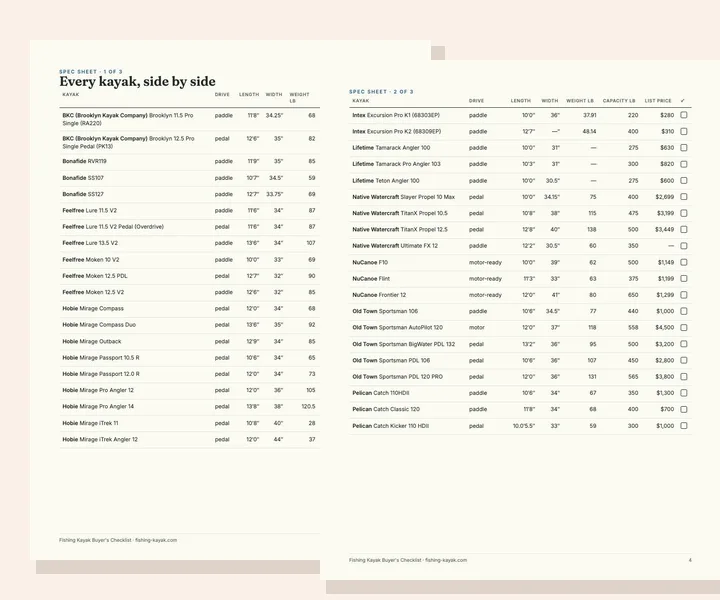
Shopping in person? The free buyer's checklist has a printable spec sheet of every kayak here.
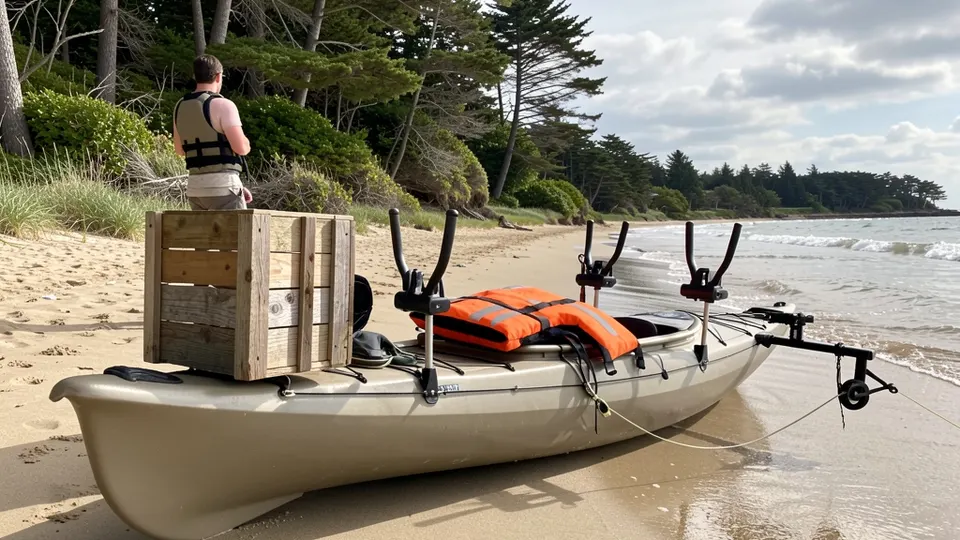
Fishing kayak weight capacity is the spec most first-time buyers misread. The number printed on the spec sheet is a ceiling, and a kayak loaded near it sits low, feels slow and takes on spray more easily. Anglers also carry more than most paddlers: crates, rods, tackle, an anchor, a cooler and sometimes a battery.
This page explains what makers mean by capacity, the rules people use to size a boat, where those rules disagree, and how length and width relate to the rating in the manufacturer specs we collected.
What counts toward the load
Capacity has to cover the paddler and everything else on board: gear, food, the paddle, a pet or a second person 1. Kokopelli makes the same point and adds that underestimating the load is a common mistake 2.
For anglers, the gear side is where estimates go wrong. A loaded crate, a tackle bag, a small cooler with ice and drinks, and an anchor add up quickly. Electronics add more: a fish finder needs a battery, and motor setups need a much bigger one. The simplest way to know your number is to weigh your loaded gear on a bathroom scale before you shop.
The 70 percent rule for fishing kayak weight capacity
Brooklyn Kayak Company describes a performance capacity of about 70% of the maximum: a kayak rated at 500 lb performs best with about 350 lb on board 1. Turned around, the rule tells you what rating to shop for.
Minimum rating = (body weight + gear weight) / 0.7
For a 200 lb angler with 40 lb of gear, that is 240 / 0.7, or about 343 lb. This is our arithmetic built on the BKC rule 1, not a figure the maker publishes. In our dataset, 46 of 53 models list a maximum of 343 lb or more, so a typical angler has plenty of choice. A 250 lb angler with the same gear needs about 415 lb, and the field narrows to 29 of the 53 models.
Other formulas, and why they disagree
Kokopelli quotes several other rules: choose a capacity 25 to 50% above your body weight, reduce the stated maximum by 30 to 35%, or add 125 lb to your body weight 2. For the same rider, these give different answers.
| Rule (200 lb angler) | Minimum rating to look for |
|---|---|
| Body weight plus 25 to 50% | 250 to 300 lb |
| Body weight plus 125 lb | 325 lb |
| 70% rule with 40 lb of gear | about 343 lb |
The body-weight rules ignore your actual gear, which is why the gear-based 70% approach comes out higher here. If you carry a heavy load, the body-weight rules can steer you to a boat that will feel overloaded. If you fish light, they may be fine. None of these is a safety standard; they are rules of thumb from manufacturers, and the conflict is worth knowing before you trust any single number.
Free printable · US Letter and A4
Get the Fishing Kayak Buyer's Checklist
The Buyer's Checklist includes a printable capacity worksheet: list your gear, add your weight, and get the minimum rating to look for before you compare models.
- Spec sheet of every kayak we track, to take to the store
- Capacity worksheet: you + gear → the kayak size you need
- Gear and safety checklist with the federal PFD rules
- Test-paddle questions and a pre-launch checklist
Usable capacity, seat limits and plugged scuppers
Some makers publish more than one number. Old Town Sportsman PDL 106 lists a 450 lb total and a 343 lb usable capacity, and Old Town Sportsman AutoPilot 120 lists 558 lb total and 406 lb usable. When a maker gives a usable figure, size against that one.
Seats can have their own limit. Hobie lists a seat capacity of 275 lb for the Mirage Outback, whose hull is rated at 425 lb, and 350 lb for the Mirage Pro Angler 12. A heavier angler should check the seat line, not only the hull rating.
On self-bailing hulls the scupper plugs can matter as well: the NuCanoe Frontier 12 spec gives 650 lb plugged but 400 lb open, so plan around the lower number if you fish with the scuppers draining. Read the notes on any model you shortlist; the headline number is not always the one that applies to how you fish.
How length and width relate to capacity
Bigger hulls displace more water, and the specs reflect it. We grouped the hard-shell models in our data by length and took the median maximum capacity. These are our calculations from manufacturer specs.
| Hard-shell length | Models | Median capacity | Median weight |
|---|---|---|---|
| Up to 10 ft 8 in | 18 | about 363 lb | 67 lb |
| 11 ft 6 in to 12 ft 3 in | 19 | 425 lb | 77 lb |
| 12 ft 6 in and longer | 11 | 500 lb | 90 lb |
One model at 11 ft 3 in falls between the groups and is left out. Width follows the same pattern: models wider than 35 in have a median capacity of 500 lb in our data, against 350 lb for those under 33 in. The trade-off is weight to carry and, usually, price. Inflatables break the pattern; some carry a lot for their weight, as covered on the inflatable fishing kayak page.
Sizing steps before you buy
Weigh yourself with the clothing and PFD you fish in, then weigh your loaded gear. Add them, divide by 0.7, and treat the result as the minimum rating. If a model lists a usable capacity or a seat limit, check those too.
If you plan to add a battery, motor or second angler later, size for that load now. Leave some margin for a big fish day, a full cooler, or a colder season with heavier clothing.
The rating is one input among several; length, width, propulsion and transport all matter. Our guide to choosing a fishing kayak walks through them in order, and the comparison table shows capacity next to weight and price for every model.
Frequently asked questions
How much weight can a kayak hold?
Every kayak has its own maximum, set by the maker. In our dataset of fishing kayaks the published maximums run from 220 lb to 650 lb. That number is the most the hull will float, not a comfortable load. Brooklyn Kayak Company suggests staying under about 70% of the maximum for good handling, so a 500 lb rating suits about 350 lb of rider and gear.
What happens if you exceed a kayak's weight limit?
The kayak sits lower, so it becomes slower, less responsive and more likely to take water over the sides or through the scuppers. Stability can also feel worse, especially when you lean to land a fish. In rough or cold water that is a real safety risk. Stay well below the rating and size up if your load is close.
Does weight capacity include the paddler?
Yes. Maker ratings cover everything on board: you, your clothing and PFD, rods, tackle, crate, cooler, anchor, paddle and any passenger or pet. Brooklyn Kayak Company and Kokopelli both stress counting gear, which anglers tend to underestimate. Weigh your loaded gear once before you shop instead of guessing.
Is a 300 lb weight limit enough for a fishing kayak?
Under the 70% rule, a 300 lb rating suits about 210 lb of rider and gear in total. That works for a lighter angler who fishes with little gear. A 200 lb angler with 40 lb of gear would want about 343 lb or more. Use the capacity calculator with your own numbers rather than a general answer.
Sources
- Brooklyn Kayak Company (manufacturer), 2023: Clarifying Kayak Weight Capacity
- Kokopelli (inflatable boat manufacturer), 2023: Kayaking Safety 101: How Much Weight Can a Kayak Hold?
- Aqua-Bound (paddle manufacturer), 2021: How to Choose: Sit-on-Top vs. Sit-In Kayaks