Fishing kayaks
Kayak Fishing Safety: Rules and Habits That Matter
By the editorial team · Updated 2026-11-25 · Specs from the makers, checked Nov 2026
Quick answer. The core of kayak fishing safety is wearing a USCG-approved life jacket, dressing for the water temperature rather than the air, and telling someone your plan. Coast Guard data shows that most boating deaths are drownings and most victims were not wearing a life jacket.
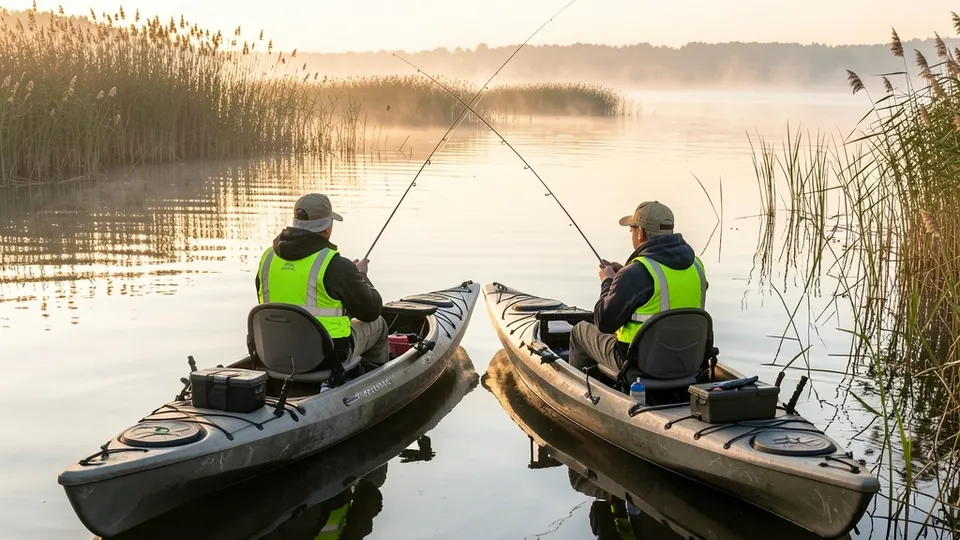
Kayak fishing safety gets less attention than rods and rigging, yet a kayak angler spends hours sitting low on the water, often alone, leaning out to land fish. This page summarizes the federal life jacket rules, a few state examples, what the Coast Guard statistics show, and the cold water facts that catch people out in spring and fall.
This is a summary of published rules and safety guidance, not legal advice. Rules differ by state and change; check your state boating agency before you go.
Kayak fishing safety: what the numbers show
The U.S. Coast Guard counted 556 recreational boating deaths in 2024. Where the cause was known, 76% of victims drowned, and where life jacket use was known, 87% of those who drowned were not wearing one 1.
The same report attributes 89 of those deaths to kayaks, and 77 of the 89 kayakers drowned; kayaks were 16% of deaths with a known vessel type 1. The pattern is consistent: capsizing a kayak is common and usually survivable, but going into the water without a life jacket on is what turns it into a fatality.
Do you need a life jacket in a kayak
Yes. Under federal rules a kayak is a recreational vessel, and it must carry at least one wearable USCG-approved life jacket for each person on board, used as its label describes 2. Racing canoes and kayaks are exempt from that carriage rule, and canoes and kayaks 16 ft or longer are exempt from the extra throwable device larger boats must carry 3.
Some retailers say the federal rule applies only to kayaks under 16 ft. That is a misreading: the wearable life jacket rule covers all lengths, and the 16 ft line only concerns the throwable 2.
Kayak PFD rules for children and by state
The federal default requires children under 13 to wear a life jacket on a vessel under way, but where a state has its own child-wear law, the state age applies instead 4.
States also go further for adults. Pennsylvania requires paddlers 12 and under to wear one, and from November 1 to April 30 requires everyone in canoes, kayaks, paddleboards and boats under 16 ft to wear one 5. Iowa's DNR states that Iowa law requires life jackets on every watercraft 6. Check your own state; some apply wear rules by season, age or water type.
The legal minimum is to carry a life jacket. The habit that matters is wearing it the whole time, because nobody has time to put one on after a capsize.

Free printable · US Letter and A4
Get the Fishing Kayak Buyer's Checklist
The Buyer's Checklist ends with a one-page pre-launch checklist: life jacket, light, sound device, float plan and weather check, ready to print and keep in the car.
- Spec sheet of every kayak we track, to take to the store
- Capacity worksheet: you + gear → the kayak size you need
- Gear and safety checklist with the federal PFD rules
- Test-paddle questions and a pre-launch checklist
Cold water kayaking
Air temperature is the wrong guide for what to wear on a kayak; NOAA's weather service tells boaters to dress for the water and to keep a life jacket on 7. A warm spring afternoon over 50 degree water is the classic trap.
Cold shock, the involuntary gasp and rapid breathing on sudden immersion, can be severe at 50 to 60 degrees F, can be triggered by water as warm as 77 degrees F, and lasts for the first two to three minutes or more 7.
For protection, the National Center for Cold Water Safety sets the line at 70 degrees F: below that, it advises a wetsuit or drysuit rather than street clothes 8. The same group notes that below 60 degrees F breath-hold time drops to about a third, and below 45 degrees F severe pain is added 9.
The 1-10-1 rule, and why it is disputed
A widely repeated rule says you have 1 minute to control your breathing, 10 minutes of meaningful movement and about 1 hour before hypothermia makes you unconscious. It is popular because it is easy to remember and stresses that time matters.
The National Center for Cold Water Safety calls it a myth that understates the danger: it argues you cannot simply control the gasp reflex, that loss of strength is gradual rather than a clean 10-minute window, and that people drown long before hypothermia sets in 10. Both views agree on the practical point: wear the life jacket, dress for immersion and plan to get out of cold water fast, not to wait.
Lights, signals and being seen
A kayak is low and hard to see from a powerboat. At night, a vessel under oars must have a white light ready to show in time to prevent a collision 11. On coastal waters and the Great Lakes, boats under 16 ft need night-use visual distress signals between sunset and sunrise 12.
Bright clothing, a flag on a pole and staying out of channels used by bigger boats help in daylight. The fishing kayak accessories page covers lights, whistles and other gear in more detail.
File a float plan and know your water
Pennsylvania's Fish and Boat Commission advises filing a float plan with a friend: where you launch, where you will fish and when you will be back 5. If you are late, someone knows where to look.
Iowa DNR's list for kayak anglers adds fishing with a partner, carrying a first-aid kit and a phone in a dry bag, checking water levels and weather, staying off the water when lightning is near, and keeping well downstream of low-head dams 6.
Practice re-boarding your kayak in shallow, warm water before you need it. Sit-on-tops can be righted and climbed back onto, but it takes practice; see sit-on-top fishing kayaks. Load the boat within its rating too; an overloaded kayak sits low and swamps sooner, as explained on fishing kayak weight capacity.
Frequently asked questions
Do you legally have to wear a life jacket in a kayak?
Federal rules require carrying a wearable USCG-approved life jacket for each person, and children under 13 must wear one unless the state sets its own age. Some states require adults to wear one too, such as Pennsylvania from November through April for kayaks. Requirements differ from state to state, so look up yours before the season starts.
What water temperature is too cold to kayak without a wetsuit?
There is no single cutoff. One clear guideline is 70 degrees F: below it, the National Center for Cold Water Safety advises immersion clothing. The gasp reflex can begin in water as warm as 77 degrees F and hits hardest around 50 to 60 degrees F. Check a water temperature reading before you pick clothes.
Is kayak fishing dangerous?
It carries real risk, mostly from capsizing without a life jacket on and from cold water. In 2024, the Coast Guard recorded 89 kayak deaths, 77 of them drownings. Wearing a life jacket, dressing for the water, staying off the water in storms, avoiding low-head dams and filing a float plan address the main causes.
What should a kayak float plan include?
At least where you will launch, where you plan to fish, when you expect to be back, your vehicle and a description of your kayak and clothing colors. Give it to someone who will act if you are late, and tell them when you are off the water. Pennsylvania's Fish and Boat Commission recommends filing one with a friend.
Sources
- U.S. Coast Guard, Office of Auxiliary and Boating Safety, 2025: Recreational Boating Statistics 2024
- U.S. Code of Federal Regulations (via Cornell LII), 2026: 33 CFR 175.15 Personal flotation devices required
- U.S. Code of Federal Regulations (via Cornell LII), 2026: 33 CFR 175.17 Exemptions
- U.S. Code of Federal Regulations (via Cornell LII), 2026: 33 CFR 175.25 Adoption of State requirement for children to wear PFDs
- Pennsylvania Fish and Boat Commission, 2026: Kayak Fishing
- Iowa Department of Natural Resources, 2026: Ready to Kayak Fish
- NOAA National Weather Service, 2026: Cold Water Hazards and Safety
- National Center for Cold Water Safety, 2026: Dress for the Water Temperature
- National Center for Cold Water Safety, 2026: Cold Shock
- National Center for Cold Water Safety, 2026: The 1-10-1 Myth
- U.S. Code of Federal Regulations (via Cornell LII), 2026: 33 CFR 83.25 (Inland Navigation Rules, Rule 25) Sailing vessels underway and vessels under oars
- U.S. Code of Federal Regulations (via Cornell LII), 2026: 33 CFR 175.110 Visual distress signals required